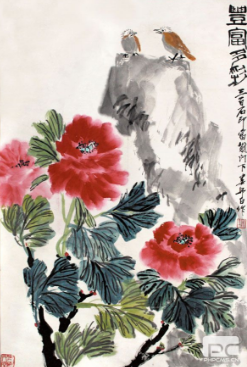
1、堂幅:俗稱"中堂"因畫幅較寬大,適宜懸掛在堂屋中間,故稱為"中堂".
1. Hall frame: Commonly known as the "nave" due to its wide frame, it is suitable for hanging in the middle of the hall, hence it is called the "nave"
2、條幅:窄于堂幅之直幅謂之"條幅",特別是窄長的條幅,形如琴者又名"琴條".
2. Banner: A straight banner narrower than the hall banner is called a "banner", especially a narrow and long banner, which is shaped like a qin and also known as a "qin stripe"
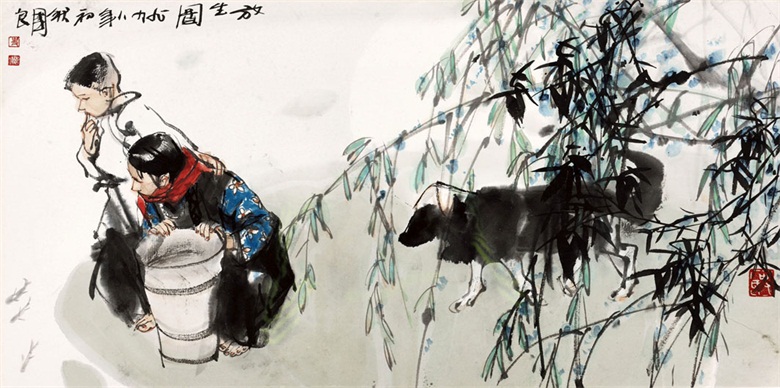
3、橫披:即橫幅的字或畫.
3. Banner: The character or painting of a banner
4、手卷:就是把名人字畫裝裱成卷子,即名人字畫橫幅之長者,不適合懸掛,只可舒卷.卷子有大有小,手卷不僅便于案頭展閱和臨摹,而且適于保管、延長名人字畫的壽命.
4. Handroll: refers to the process of mounting famous calligraphy and paintings into a roll, which is the longer the banner of famous calligraphy and paintings. It is not suitable for hanging, but can only be unfolded. The roll can be large or small, making it not only easy to display and copy on the desk, but also suitable for storing and extending the lifespan of famous calligraphy and paintings
5、屏條:即書畫成堂的屏條,常見的有四條、六條、八條、十二條多為十六條. 不能單掛多有四季景或臨摹名家的繪畫等.
5. Screen Strips: Refers to the screen strips used in calligraphy and painting, commonly consisting of four, six, eight, and twelve, with a maximum of sixteen It is not allowed to hang multiple seasons or copy paintings from famous artists
6、冊頁:就是把名人字畫分成頁數(shù)裝裱成冊子,稱為"冊頁".冊頁一般分為八開、十二開、 十六開 多為二十四開,都是雙數(shù).發(fā)現(xiàn)有單數(shù)者即為殘缺,俗稱失群冊頁冊頁有大有小, 小的冊頁稱為袖珍冊頁.
6. Album: refers to the process of dividing celebrity calligraphy and paintings into pages and mounting them into a booklet, known as a "album". Album pages are generally divided into eight, twelve, and sixteen, with a maximum of twenty-four, all of which are even in number. If an odd number is found, it is considered incomplete, commonly known as a "lost group album". Album pages vary in size, and the smallest album page is called a pocket album
7、對聯(lián):俗稱對子.兩條的字?jǐn)?shù)一樣多,上下文辭相呼應(yīng).故稱"對子".另外,有"龍門對", 因字多不能直書一行,則寫為兩行,上條由右而左,頭行字多末行字少下條,由左而右, 亦頭行字多,末行字少,相對掛起,字如"門"字,故稱之為"龍門對". 上條和下條均由右面左的一樣寫法的稱之為"順龍門".
7. Couplet: Commonly known as couplet. The two lines have the same number of words and correspond in context, hence the name "couplet". In addition, there is "Longmen Pai", which cannot be written directly in one line due to the large number of characters. The upper line is written in two lines, with the upper line from right to left, the first line being more, the last line being less, and the lower line being more, and the left to right. It is also known as "Longmen Pai", which has more first line characters and fewer last line characters, and is relatively hanging. The characters are like the "gate" character, hence it is called "Longmen Pai" The upper and lower bars, both written in the same way as the one on the right and left, are called "Shunlongmen"
8、扇面:就是書畫家,在扇面上寫的字或畫的畫,故稱之為"扇面".
8. Fan: refers to the characters or paintings written or drawn by calligraphers and painters on the fan, hence it is called "fan"
Thank you for reading. The source of this article is: Acquisition of Famous Calligraphy and Painting. For more information and questions, please click on: http://www.yidajxc.com We will continue to work hard to provide you with services. Thank you for your support!

 發(fā)布時間:2023-09-15
  作者:大雅堂美術(shù)館
  文章來源:http://www.yidajxc.com/
  瀏覽量:0
瀏覽量:0






 首頁
首頁 產(chǎn)品
 電話
電話 置頂
置頂